


Shoppers have chosen who they are most comfortable buying from internationally, and the answer is right next door.
A 1,000-person survey conducted in August reveals that 83% of respondents said they'd be comfortable buying from an online seller based in Canada while 38% said the same thing about India. Additionally, nearly 8 in 10 shoppers admit the biases start with them, as they've assumed a product was less safe or of lower quality, mainly because of the country it came from.
But that's not all this survey turned up. Commissioned by EveryMarket, an online marketplace, it showed that a majority of the respondents are wary of overseas sellers, and half have even lost money on an international order. Yet, there are some who keep buying from global sellers.
Canada Wins in Comfortability
This is the full ranking of which countries the respondents were comfortable with:
- Canada: 83%
- United Kingdom: 77%
- Japan: 70%
- Germany: 69%
- South Korea: 56%
- Mexico: 53%
- China: 43%
- India: 38%
Canada is the most trusted country, leading the pack at 83% of respondents feeling most comfortable buying from an unfamiliar online seller based in that country. India is last, but only by 5 percentage points behind China.
The information in this survey matches earlier studies done. According to a Conference Board survey in August 2025, Canada was viewed as the most favorable among the country's top three import partners, and places like India, Bangladesh, and Vietnam were seen as less as favorable.
The ranking doesn’t explain how it got that way. That’s the next question.
Majority of Shoppers Admit to Personal Bias
Nearly 8 in 10 (78%) of shoppers said they’ve assumed a product was lower quality or less safe, mainly because of its country of origin. Nearly a quarter (24%) say they do it often, and 4 in 10 do it sometimes. 14% said they’ve caught themselves doing it and now try to judge products one by one. The remaining 22% said they judge by brand and product.
The ranking doesn’t specify if the countries earned their place on it. It only shows what shoppers think. And though small, those in the 14% group are trying to do something about it. This begs the question, are these biases enough to keep people away?
Shoppers Are Wary But Still Buying
Just over three-quarters of shoppers (76%) have bought a product outside the United States, and just over a quarter (27%) say they do it routinely.
EveryMarket
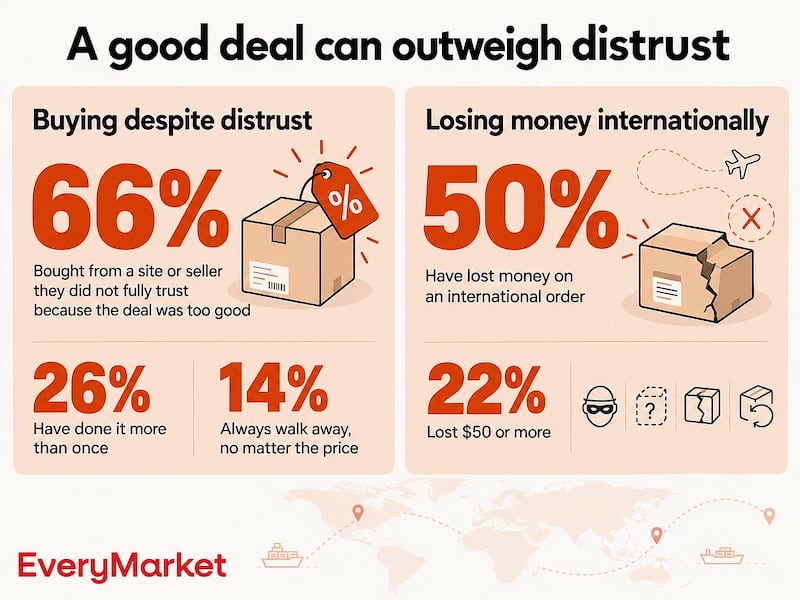
A good price sweetens the deal. Two-thirds of shoppers said they bought from a website or seller they didn’t trust because the deal was too good to pass up, with 26% doing it more than once. Notably, that question covered both domestic and international sellers, so the question isn’t a measure of international shopping on its own.
Just 14% said they would walk away from a seller they don’t trust, no matter the deal, and there is reasoning behind this. Half the respondents said they lost money on an international order because the product was fake, never showed up, arrived damaged, or couldn’t realistically be sent back. Over 2 in 10 (22%) said they lost $50 or more.
If people still buy even though they are wary, what actually stops a purchase?
Shoppers Worry About Fakes, But Fees Kill the Cart
The survey asked what a respondent’s single biggest worry was before buying from an overseas seller. The biggest worry was counterfeits (32%), followed by packages that never arrive (28%).

EveryMarket
Unexpected customs, duties, or fees were the top worry of 7%. Yet that’s the straw that breaks the camel’s back. Once the respondents reached checkout, half of them abandoned an international purchase because of fees. Nearly a third (32%) have done it more than once.
And the fees won't be going away anytime soon. In fact, the costs have climbed since August 2025, when the U.S. suspended the duty-free "de minimis" exemption for packages valued at $800 or less from every country, and is set to expire permanently in July 2027.
Methodology
EveryMarket, an online marketplace based in the United States, surveyed 1,000 U.S. adults through the polling platform Pollfish in August 2026. The sample is not weighted, and leans female and young. Every respondent rated all eight countries on the same 4-point comfort scale, so the country comparisons come from the same sample, not separate polls.
This story was produced by EveryMarket and reviewed and distributed by Stacker.